
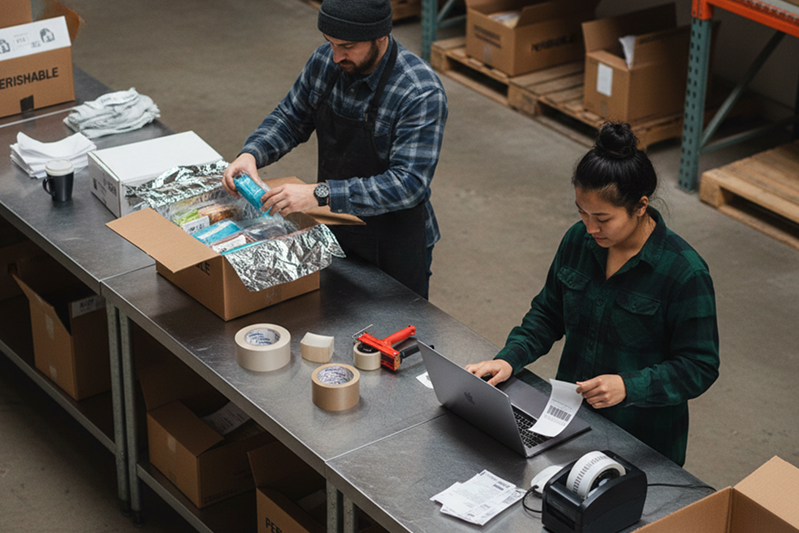
When you run a DTC food company, there's nothing more important than making sure each customer enjoys the very best of what you have to offer—without ever feeling frustrated or concerned about their perishable shipments. Fresh, chilled, and frozen food & beverages must be delivered safely and transparently, showcasing the quality of your products along with your brand's high standards. The problem is what's outside of your control: delivery issues, temperature fluctuations, and untimely delays constantly work against you, diminishing your customers' experience and confidence. To win in today's high-cost, high-expectation environment, you need specialist perishable shipping tools you can rely on every day.
What Are Perishable Shipping Solutions?
Perishable shipping solutions are a set of specialized parcel logistic services for items that spoil if not treated to consistent temperature ranges and suitable handling.
Why Perishable Shipping Efficiency is the Core of Your DTC Food Business
DTC perishable brands face unique logistical challenges that are far easier said than done to overcome on a weekly basis. Much of the problem involves maintaining a cold chain that ensures sensitive shipments adhere to tight delivery windows under various temperature conditions, at the lowest possible cost. You'll need technology to intelligently select the most efficient delivery method, coverage, and packaging configuration for each customer to operate profitably, preserve confidence, and prevent losses.
We can start by simplifying what perishable shipping means by breaking it into smaller parts:
#1 Perishable Shipping Maintains Product Integrity
All perishables must be transported and stored in a manner that maintains a consistent temperature range. From your warehouse to your customer, the temperature range must be maintained despite potential issues with:
- Temperature spikes during loading, unloading, and transport
- Equipment and vehicle malfunctions, weather abnormalities, service outages, or demand spikes
- Weather at the destination address during and after delivery
#2 Perishable Shipping Accounts For Short Product Shelf Life
Just because a delivery arrived on time doesn't necessarily mean success. The sensitive nature of many perishables (such as fresh seafood or raw juice) means your customers may not feel comfortable consuming your product unless it arrives COLD. Perishable products arriving slightly cool or lukewarm won't be acceptable to most consumers, resulting in a loss to you. To avoid this, adjustments to your shipping service selection and/or packaging configuration are typically required.
- Perishables are typically delivered using a "just-in-time" model where even minor delays diminish customer confidence
- Shipments arriving at the end of a shipping day may not arrive cold enough, depending on the weather
- Weather awareness of each address is essential. Automated decision-making for shipping service selection and packaging configurations is the new industry standard and is the key to operating efficiency and success
#3 Perishable Shipping Requires Some Regulatory Compliance
Many perishables, such as fresh herbs, leafy greens, sprouts, fish, eggs, and raw juice, are considered "high risk" by the FDA and are more carefully regulated to protect consumer health. Breaks in the cold chain can introduce harmful bacteria, potentially causing serious illnesses to anyone who consumes an adulterated product. You must go through great lengths to keep your products at the correct temperature:
- Monitor carrier service outage alerts and potentially late shipments in real time to detect issues long before potentially temperature-abused products are consumed, or prevent them altogether
- Detailed record-keeping to ensure compliance with the FDA's stringent FSMA
- CFR 49 and IATA Compliant labeling for perishable shipments containing dry ice and other materials classified as hazardous
#4 Perishable Shipping Shapes Business Operations
The sensitive nature of perishable goods requires shipping operations to be ultra-efficient and agile at all times. As you’ve probably noticed, profit margins are quickly reduced by specialty packaging materials, coolants, higher-cost shipping services, and delivery mishaps. If you're not leveraging technology to fully optimize each shipment, you're almost certainly losing money on a significant number of orders. Luckily, there are ways for significant gains to be made:
- Strategic application of shipping insurance, rule automations, zone mapping, and intelligent shipping service selection for every order can dramatically reduce overall shipping costs
- Customer confidence and delivery expectations can be significantly improved with clear delivery ETAs, alerts, and streamlined resolutions when deliveries go wrong
- Retention rates and customer LTVs significantly increase with a consistent, transparent, and reliable perishable delivery experience
In order to maintain product integrity, ensure regulatory compliance, and optimize your entire shipping operation, it's essential to have the correct tools and software at the core of your business—a flexible, comprehensive system that seamlessly adapts to your needs and scales as your brand grows.
What Counts as Perishable? Understanding Temperature-Sensitive Goods
Perishable goods are any food, beverage, or product likely to spoil, become unfit for human consumption, or start to decay outside a defined temperature range. In the US, the temperature-controlled conditions that must be followed are refrigeration at 40°F (4°C) or less, or freezing at 0°F (-17°C) or less.
Perishable goods come in a wide variety of types. The most common categories are:
- Meat & Poultry: Uncooked meat, steaks, roasting meat, raw sausage, and all poultry products
- Seafood: Fresh fish, shellfish, frozen fish, and other marine life caught for human consumption
- Fresh Produce: Exotic fruits, vegetables, herbs, and mushrooms
- Dairy Products: Milk, cream, yogurt, butter, and many cheese varieties (particularly soft/spreadable)
- Eggs: Fresh eggs in their shells, regardless of bird species
- Prepared Meals: Prepackaged meals that require refrigeration before consumption
- Specialty foods: Cold-pressed juices, chocolate, kombucha, truffles, caviar, baby food, raw pet food, and many more
One major hurdle perishables brands must overcome is time-temperature sensitivity. When cold foods are kept above the 40°F (4°C) limit, they're in a temperature range that actively promotes the growth of potentially harmful bacteria. If the limit is exceeded for just 20 minutes, the number of bacteria can double. Food is typically recommended for disposal if it remains in this zone for more than 2 to 3 hours.
Temperature-Sensitive Goods Determine Packaging Choices
Perishable goods must be packed and transported in a manner that protects them from spoilage and contamination to ensure their quality and safety. Packaging needs to be durable, food-safe, and perform well enough to control temperature throughout each shipment's journey. Each shipment will have a different journey throughout the year, even for repeat customers, so it's essential to have more than one packaging configuration to enhance your operational efficiency throughout the year. Here are the basics to know:
- Temperature Regulation: Insulating materials such as foam, foil, or paper liner combined with refrigerants or dry ice are required to maintain consistent temperature ranges, depending on the product type
- Moisture & Gas Control: Preventing leakage from product or gel pack damage is important to your customers' unpacking experience and can determine if carriers discard your package entirely during transit. Shipments with dry ice must not be completely airtight, allowing gas to escape during transit to avoid rupture
- Hygiene & Protection: All materials should be clean and hygienic, and in some cases tamper-proof to prevent contamination
- Smart Features: The latest packaging solutions can come with time-temperature indicators (TTIs) that track the shipment's environment from beginning to end, though this is typically reserved for sensitive and expensive pharmaceutical products
We're now ready to take a closer look at the specific packaging options that allow perishable shipping solutions to function.
Temperature-Controlled Packaging Essentials
The foundation of every successful perishable shipment is packaging that actually works—packaging you can trust to withstand specific time and temperature conditions.
Insulation Options
Polyurethane foam offers the highest R-value per inch (a measure of how effectively an insulation material resists heat flow per inch), making it the most thermally efficient option. It's lightweight and conforms well to products. However, it's the most expensive and least environmentally friendly. Use polyurethane when maximum thermal performance is required for long transit times or extreme temperatures.
EPS (Expanded Polystyrene) delivers strong thermal performance at a lower cost than polyurethane. It's rigid, durable, moisture-resistant, and widely available in various thicknesses and pre-formed shapes. The downsides are bulk and environmental concerns—it's not biodegradable, and recycling is limited. EPS is well-suited for high-volume operations where cost is the primary concern.
Paper-based insulation provides an eco-friendly alternative made from recycled materials. It's biodegradable, compostable, and performs adequately for short transit in moderate temperatures. However, it offers lower thermal performance than foam, can lose effectiveness when wet, and requires more thickness for comparable performance. Choose paper when sustainability is a brand priority and conditions are favorable.
Denim/Cotton fiber insulation is made from recycled textile waste, offering excellent eco-credentials and strong appeal to sustainability-focused brands. It offers good thermal performance—better than paper but not quite as good as foam—while being breathable, moisture-wicking, and safe to handle. The material is flexible and can conform to various product shapes. However, it's far heavier and more expensive than paper or EPS, has limited supplier availability, and requires protection from moisture during transit. Choose denim/cotton insulation when you want premium, sustainable packaging with solid thermal performance.
Foam bubble insulation combines reflective foil with bubble wrap for dual-action control—deflecting radiant heat while providing air-pocket insulation. It's flexible, lightweight, and works well for irregular shapes. The limitation is lower thermal performance, making it suitable for shorter transit times or less sensitive products. Use when you need flexibility and moderate protection at a reasonable cost.
Cornstarch-based insulation is the newest sustainable option, offering biodegradable properties that dissolve in water. It performs comparably to EPS while addressing environmental concerns. However, it's more expensive, has more limited availability/supplier options, and can degrade if exposed to moisture during transit. Consider when sustainability is a key brand differentiator.
The insulation decision is about matching thermal performance to transit duration, external temperatures, and product sensitivity. A chocolate assortment heading to Phoenix in July demands different insulation than fresh pasta going to Seattle in February.
Cooling with Dry Ice
Dry ice is the workhorse of frozen shipping. At -109°F, it provides deep, sustained cooling that gel packs cannot match. But it's a Class 9 hazardous material with strict DOT and IATA requirements.
Your shipping label must clearly display "UN 1845" and the net weight of dry ice. Include "PERISHABLE" and hazard class markings. UPS requires a Class 9 diamond hazard label for shipments containing over 5.5 pounds of dry ice—verify carrier-specific requirements is something else that must be considered before shipping.
The package must be vented—as dry ice sublimates, it releases CO2 gas that can cause sealed containers to rupture. Gloves should be worn at all times when handling dry ice to prevent burns or injury.
Plan on ~5 pounds of dry ice for every 20lbs of product, per 24 hours in transit. These amounts can vary depending on how well climate-controlled your products are when being packed, along with the weather. Working with a specialist shipping platform that manages dry ice compliance isn't just easier—it's how you avoid expensive mistakes.
Cooling with Gel or Ice Packs
For chilled products, gel packs offer a simpler, cheaper alternative to dry ice for products that do not require freezing. They do not contain hazardous materials, don't require special labeling, and don't need vented packaging.
Ice packs (or Gel packs) use a mixture of water and gel polymer to stay colder and drier than simple ice. Both are food-safe and reusable, but they should be prevented from bursting or leaking during transit. Often, ice packs can be compromised during transit before they are frozen. Always source your ice packs from a reputable supplier and check the boxes they arrive in for leaks before freezing.
Position gel packs on all sides of the products for uniform cooling. A standard rule is one pound of gel packs per 4 pounds of product for 24-hour delivery, adjusted for external temperatures and product sensitivity.
Packaging Best Practices
Eliminate voids. Air pockets create convection currents that accelerate heat transfer and allow cooling elements to shift during transit.
Pre-cool everything. Refrigerate products before packing, pre-chill containers, and add cooling elements until the last moment before they’re released to the carrier. Avoid keeping your shipments unrefrigerated or use insulated pallet covers when necessary.
Plan for condensation. Use vented packaging and water-absorbing desiccant packs for products that need to stay dry.
Double-bag liquids. A leak doesn't just ruin the order—it can cause carriers to discard your shipment entirely.
Test before you trust. Conduct drop and thaw tests to identify weaknesses before they damage your customer experience.
Carrier Selection & Shipping Speed: Making the Right Choice
Choosing the right carrier isn't a one-time decision—it's a calculation for every order based on destination, conditions, and product requirements.
Carrier Options
FedEx has built a strong reputation in temperature-controlled shipping thanks to extensive express networks and its Memphis hub-and-spoke air network. Often preferred for overnight shipments.
UPS offers comparable reliability with competitive pricing, particularly for two-day services and regional shipments. Drivers typically have the same routes every day, building better customer relationships and ensuring predictable pickup windows.
USPS can work for regional deliveries, but its food shipping policies are stricter (5 lb dry ice limit per package), and both tracking and reliability lag behind FedEx and UPS.
Shipping Speed
Overnight shipping is the safest and most reliable service because of the speed. Also known as Next Day Air, Next Day Air Saver, Priority Overnight, or Standard Overnight, using these premium shipping services means shipments will have minimal temperature exposure and the highest probability of success. Costs can vary greatly depending on the size and weight of the shipment, typically ranging from $40 to $80 per package. Therefore, it's essential to implement healthy order minimums when using these services.
Two-day shipping is typically cheaper, but delivery success rates and customer satisfaction are generally lower than those of overnight services. Maintaining refrigerated temperatures is more difficult simply due to the additional time in transit, along with other deliverability issues that naturally arise. Two-day services are typically used for shipments that contain dry ice, going to low-risk addresses with cool weather expected.
Ground shipping is the cheapest method, but comes with no guaranteed delivery date from the carriers. Ground is best for short-distance deliveries with expected delivery windows of 1-2 days at most. During peak demand seasons, Ground shipment transit windows can become unreliable. Insurance will not cover losses from delays if delivery is made within 5 days.
Managing Complexity
Every carrier has cut-off times that vary by service level, destination, and day of the week. Miss the cut-off and your shipment sits until tomorrow, doubling spoilage risk and ruining your customer’s delivery expectation. Holiday periods and weekends compound this. You must be aware of each carrier's requirements and adjust your schedule accordingly. Establishing automated pick-ups or scheduling reminders can help with this.
Step-by-Step: How to Ship Perishable Goods
Shipping perishables successfully requires following a systematic process where each step builds on the previous ones. Here's the complete workflow professional operations use:
Pre-Shipment Planning: Create Your Shipping Rules
Before shipping a single order, you must determine the packaging configuration for your product type and delivery scenario. Determine your insulation and coolant quantities based on different transit times, customer zone/location, product, and weather conditions. Define which shipments will need overnight service, 2-day versus ground. Do you have a maximum allowed transit time? Specify your upgraded packaging during summer months or for higher temperatures in general. Document the exact number of gel packs or pounds of dry ice required for each product or shipment, specifying the corresponding transit times and weather conditions. These rules ensure consistency and eliminate guesswork when orders flow in.
Step 1: Assess Your Daily Shipments
Now that your shipping rules are in place, you’re almost ready to ship. Each morning, review all orders that need to be fulfilled for the day and determine the most appropriate, cost-effective shipping service based on your rules from Step 0. Once determined, you now know exactly which packaging to use and how much coolant is required. Without the right software, manually determining these variables at scale for each shipment every day is nearly impossible. Once your shipments are ready, generate a picklist or manifest that totals all products, boxes, insulation, gel packs, and/or dry ice required for the day to complete your orders.
Step 2: Print Labels and Pack Your Shipments
Print your shipping labels and packing slips using a reliable thermal label printer. Construct your outer shipping boxes and then apply each shipping label and packing slip to the inner and outer flaps of the box. Packing slips should list both products and materials required—insulation type, gel pack count or dry ice pounds, and special handling notes, so that each box is packed exactly as required. Pack methodically: pre-cool containers, position coolants with buffer layers, eliminate voids, double-bag liquids, and verify vented packaging for dry ice.
Step 3: Prepare for Carrier Pickup
Keep packed shipments in cold storage or insulated areas while awaiting pickup. Don't let boxes sit at room temperature—every minute of heat exposure degrades the effectiveness of your packaging for the desired transit time. Organize by carrier and have shipments ready before the scheduled pickup window. Coordinate pickup timing as late in the day as possible.
Step 4: Monitor, Communicate, and Learn
Send shipping confirmations to your customers as soon as they’re picked or received by the carrier and provide updated delivery ETAs and tracking information. Direct customers to your branded tracking page rather than carrier sites when they’re interested in viewing the status of their order. Actively monitor shipments for service alerts, delays, or exceptions. Communicate proactively when issues arise—explain what's happening and provide them with updated ETAs if necessary. If they experience a delivery issue, provide them with a direct way to file a claim with you for resolution. Once delivered, follow up to confirm the delivery was made and request feedback on their experience. This feedback identifies weaknesses in your shipping rules, packaging, or carrier performance, for your continuous improvement.
Shipping Specific Perishable Products
Frozen Foods
Pre-freeze products to -10°F or lower before packing. Use polyurethane or EPS foam insulation with adequate thickness for your transit time. Calculate 4-5 pounds of dry ice per 24 hours in transit, adding extra for summer or high-risk zones. Ensure vented packaging to allow CO2 gas escape.
Chilled Meat
Fresh meat ships at 32-38°F. Use 1 pound of refrigerant per 4 pounds of meat for each transit day. Add more depending on the transit time and weather conditions. Never ship fresh meat on Friday unless using Saturday delivery and delay insurance. Ship overnight.
Seafood
Use leak-proof liners and absorbent pads—seafood leaks create catastrophic odor problems that cause carriers to reject packages. For fresh seafood, pack with gel packs positioned around (not touching) the product and ship overnight. For frozen seafood, use 1 pound of dry ice per 3 pounds of frozen seafood for each transit day—fish thaws faster than meat. Ship Monday through Wednesday only to avoid weekend delays.
Cold-Pressed Juice
Juice must stay below 38°F. Use 1 pound of refrigerant per 4 pounds of juice for each transit day. Pack bottles tightly with ice packs in a “sandwich style” to minimize movement and maintain temperature—overnight shipping strongly advised.
Chocolate
Ship at 54-68°F with humidity below 50%. Use foil bubble or reflective insulation that deflects rather than absorbs heat. Gel packs require substantial separation from chocolate—direct cold contact can cause bloom. Summer shipping to hot climates requires overnight service plus upgraded insulation, or don't ship at all.
Prepared Meals
Maintain 36-40°F and limit transit to 48 hours maximum. Use leak-proof meal containers with secure seals that withstand pressure changes during air transit. Position gel packs around meals (top, bottom, sides) with insulation separating them from direct contact. Pre-cool meals to 34-36°F before packing.
Fresh Produce
Use molded pulp inserts or foam dividers to prevent movement and cushion impacts. Pack with slight compression to prevent shifting, but not tight enough to cause bruising. Critical detail: apples, bananas, and avocados release ethylene gas that causes other produce to ripen rapidly. Never pack these with peppers, berries, or leafy greens—use dividers and separate bags for mixed produce. Overnight shipping is essential.
Perishable Shipping Insurance & Loss Protection
Standard carrier insurance explicitly excludes perishables or provides limited coverage. You need specialized perishable insurance that covers temperature deviations, spoilage, handling issues, and most importantly, delays.
All-risk coverage protects against external causes, such as rough handling, fires, and theft.
Weather endorsement coverage protects your shipments when extreme weather conditions—heat waves, cold snaps, storms—cause delivery delays that can cause spoilage or loss of confidence in your customer. This endorsement acknowledges that weather events beyond your control can compromise product integrity, despite adhering to all best practices.
Time-in-transit coverage(also known as delay coverage) protects against extended transit times resulting from carrier operational failures, strikes, customs inspections, mechanical breakdowns, or weather-related service suspensions. When shipments take longer than expected to reach their destination, even perfect packaging eventually loses its protective capacity. This coverage responds when delays outside your control cause spoilage.
Why Claims Fail
The primary reason perishable insurance claims fail is poor documentation—specifically, unclear proof of customer compensation. Insurers need to verify that you actually incurred a loss by refunding or reshipping your customer.
Claims fail when you cannot provide evidence of the refund (credit card confirmation or transaction timeline) or replacement shipment documentation (tracking number, packing slip, invoice). Without proof of compensation, insurers question whether a legitimate loss occurred.
Secondary failures include missing temperature data, insufficient damage photos, incomplete invoices that do not accurately reflect product value, or inadequate packaging. The difference between successful claims and absorbed losses lies in documentation discipline—maintaining clear, undeniable records of every refund and replacement, as proof of compensation validates your claim.
Cost Optimization Strategies
Shipping perishables costs much more than durable goods, but strategic optimization can reduce spend by 30% or more.
Cutting Shipping Costs
Leverage multiple carriers strategically—FedEx might be better for the West Coast, while UPS is cheaper for the Southeast. If your business is brand new, you should not establish a direct account with the carriers right away. It will be more difficult to keep up the higher volumes required in order to maintain the highest discounts offered to you. A group enterprise account with each carrier can allow you access to the best prenegotiated rates without a direct agreement. Once you have enough volume for your own agreements, it will be far easier to negotiate with the carriers to get even better rates on your most used services. You can then use your group account to supplement any discount gaps.
Zone-Based Strategies
Establishing strategic fulfillment hubs or 3PL companies can allow you to ship wider parts of the country with less expensive shipping services, such as 2-day and Ground. Typically, this is only possible with higher volumes, as the savings in shipping costs must be higher than the fees charged by the 3PL or extra overhead of an additional warehouse.
Packaging Efficiencies
You should have at minimum two packaging configurations for your shipments, such as a summer and winter pack, or a 1-day transit pack and 2-day transit pack. Establishing your own company shipping rules for your particular products and situation will pay dividends in the future. Using the right software will help automate your shipping rules tremendously.
Service Guarantee Refunds
Apply for Guaranteed Service Refunds (GSRs) when the carriers make mistakes or deliver your shipments late. They will not automatically credit you, so you must manually apply for them. Each carrier makes it a tedious and difficult process to apply, so it's helpful to use software or a service to assist with this. This is money owe to you for shipping services that were paid for but not adequately performed.
Understanding Hidden Costs
Dimensional weight pricing punishes oversized packaging. Surcharges and extra service fees can quickly double the original cost of a shipment. Overweight fees beyond 150lbs cost you thousands of dollars if you're not careful. Make sure to monitor that your surcharge discounts are in place each; if they expire, the carrier may not notify you. Be aware when demand surcharges are in place or when service guarantees are suspended, which typically happens during the holiday season.
Weather & Environmental Risks
The weather doesn't care about your products, schedule, or your customers' delivery expectations. Heat waves, rain, and storms will repeatedly test your shipping operations throughout the year.
Weather Reality
Transit delays multiply during storms. Loading dock conditions expose packages to extreme temperatures during vulnerable moments—summer heat on asphalt can exceed 140°F. Delivery doorstep exposure occurs when customers aren't home.
Predictive Strategies
Monitor weather forecasts at both your warehouse and destination on the expected delivery day. Establish weather-based shipping rules that trigger automatically when conditions exceed thresholds. Build risk scoring into your shipping rules. Plan seasonally, not reactionally.
Heat Waves
Add cooling capacity aggressively—if normal shipments use three gel packs, heat wave shipments need five or six. Use a thicker liner and upgrade shipping speeds to overnight during peak heat. Paying more for shipping and packaging costs during heat waves is far better than issuing refunds for failed deliveries. Pay for shipping insurance.
Cold Snaps
Reduce coolant quantities and liner thickness when shipping to cold destinations. Use Ground when transit days are expected 2 days or less instead of using a guaranteed two-day service. Remove insurance. Monitor delivery conditions closely during winter storms.
Storms
Track carrier service alerts and stop shipping to affected areas immediately. Check with your account representative when normal service is expected to resume. Use a different, unaffected carrier if possible. Proactively reroute or delay shipments rather than letting them enter disrupted networks. Prepare customer communications for storm-related delays.
The Role of Perishable Shipping Software
Technology separates perishable brands that struggle from those that scale confidently. Manual processes cannot handle the complexity and speed of decision-making that modern perishable logistics demand.
Why Generic Software Fails
Generic e-commerce platforms were designed for durable goods. They lack temperature-based logic, weather awareness, dry ice compliance, perishable insurance management, and shipping rule logic. Manual workarounds break down under volume and prevent scaling.
What Perishable-First Software Provides
- Live weather tracking monitors conditions and automatically adjusts packaging, shipping speeds, or restrictions.
- Delivery risk scoring evaluates orders and provides clearer guidance on insurance and extra service selection.
- Intelligent order splitting happens automatically when customers order products with different temperature and packing requirements.
- Dry ice compliance generates proper labels, calculates quantities, and assists with documentation.
- Multi-carrier service logic automatically selects the lowest shipping cost for each shipment based on the maximum allowed transit day.
- Perishable insurance management streamlines claims with an integrated API directly to the insurer.
- Live Shipping Schedule and ETAs at your store’s checkout page can substantially increase conversion rates and give your customers more confidence when ordering from you.
- Order Protection allows your customers to pay for their own peace of mind and submit their delivery issues directly to you for professional, streamlined handling.
- Late Shipment Alerts can identify late shipments quickly, so that your customers can be swiftly alerted.
The Operational Impact
Costs decline by 15-30% within days. Scaling becomes possible because the system handles the complexity of your entire shipping operation. Customer experience and confidence improve through better communication, improved delivery rates, and peace of mind. Claims become a breeze to manage and file. Compliance becomes automatic. Revenue increases with order protection and higher checkout conversion rates.
Software Comparison
| Capabilities | Perishable-First Software like ShipFare | ShipStation | ShipperHQ | Generic fulfillment software | DIY solutions |
|---|---|---|---|---|---|
| Multi-Carrier Support | Yes | Yes | Yes | No | Depends |
| Temperature Logic | Yes | Not supported | Not supported | Not supported | Maybe |
| Dry ice compliance | Yes | Maybe | Yes | Not supported | Maybe |
| Weather risk awareness | Yes | Not supported | Not supported | Not supported | Not supported |
| Perishable split box | Yes | Basic | Yes | Maybe | Maybe |
| Perishable insurance | Yes | Yes | No | No | No |
Choose based on where your business is going. Evaluate on feature completeness for your needs. Consider the total cost, including implementation, training, and errors. Test the support model—you need teams who understand perishable logistics when problems arise.
Conclusion
Shipping perishables successfully requires building a comprehensive system that integrates technology, processes, and continuous improvement to achieve consistent and efficient outcomes. The brands that thrive treat shipping as a core competency deserving investment rather than a necessary evil.
You can't eliminate every risk—weather will sometimes overwhelm perfect packaging, carriers will occasionally lose packages, and unpredictable events will create problems. However, you can build systems resilient enough to handle these challenges without compromising customer trust or damaging your economics.
Whether you're shipping your first orders or scaling to thousands weekly, the fundamentals remain: understand your products' requirements, engineer packaging systems that reliably meet them, choose carriers strategically, monitor performance obsessively, and invest in technology that makes this manageable at scale.
ShipFare exists to support DTC food and beverage brands through every stage of this journey. Ready to transform your perishable shipping operation? Book a demo with our team or start connecting your e-commerce platform now.
Frequently Asked Questions
How do you ship perishable food?
Start with insulated packaging (EPS foam or polyurethane) and the right coolant — gel packs for refrigerated products (32–40°F), dry ice for frozen (0°F or below). Use overnight or 2-day express services from FedEx or UPS. Ship Monday through Wednesday. Set an internal order cutoff at 1:00 PM. Pre-freeze frozen products to 0°F for 24 hours before packing.
How much does it cost to ship perishables?
A typical overnight frozen shipment costs $39–$76 total (carrier rate + packaging + dry ice + labeling). Refrigerated shipments using gel packs are cheaper since gel packs are reusable and require no hazmat labeling. Most DTC brands find shipping represents 15–30% of order value. Multi-carrier routing typically saves 15–20%.
What carriers are best for perishable shipping?
FedEx and UPS are the two primary carriers. FedEx is often preferred for overnight due to its Memphis hub network. UPS offers competitive 2-day pricing and consistent driver routes. Neither offers cold packaging for food shippers. Most successful brands use both and route each order to the cheapest qualifying option.
Do I need special insurance for perishable shipments?
Yes. Standard carrier insurance excludes perishables. You need specialized coverage for temperature deviations, spoilage, and delays. Look for weather endorsements and time-in-transit coverage. Document every refund and replacement — claims fail most often due to poor proof of customer compensation.
How much dry ice do I need?
For a 12×12×12″ insulated box with ~30 lbs of frozen product: ~4 lbs for Priority Overnight, ~5.5 lbs for Standard Overnight, ~10 lbs for 2-day, ~15 lbs for 3-day. These are baselines — larger boxes, heavier loads, and summer heat require more. Always pack for the delay, not the promise.
Can I ship perishables internationally?
Yes, but it's more complex and expensive. Canada is the most accessible market for US food brands — you'll need a Safe Food for Canadians License, bilingual labeling, CUSMA documentation, and packaging rated for customs delays. Other international destinations face longer transit, customs holds, and country-specific regulations.
How to ship temperature-sensitive items?
Identify exact temperature ranges for your product. Choose insulation sufficient for transit duration. Select coolants to maintain required temperatures. Use express shipping to minimize exposure. Work with FedEx and UPS. Avoid weekend and holiday windows. Monitor weather and adjust packaging or withhold shipments when conditions are risky.
How to choose a logistics visibility system?
Choose a system built for perishables with real-time tracking across carriers, live weather monitoring, delivery risk scoring, and automated shipping rules. Essential features include perishable insurance integration, branded tracking pages, dry ice compliance, and automatic order splitting for mixed-temperature shipments. Generic tools designed for durable goods force manual workarounds that break at scale.