
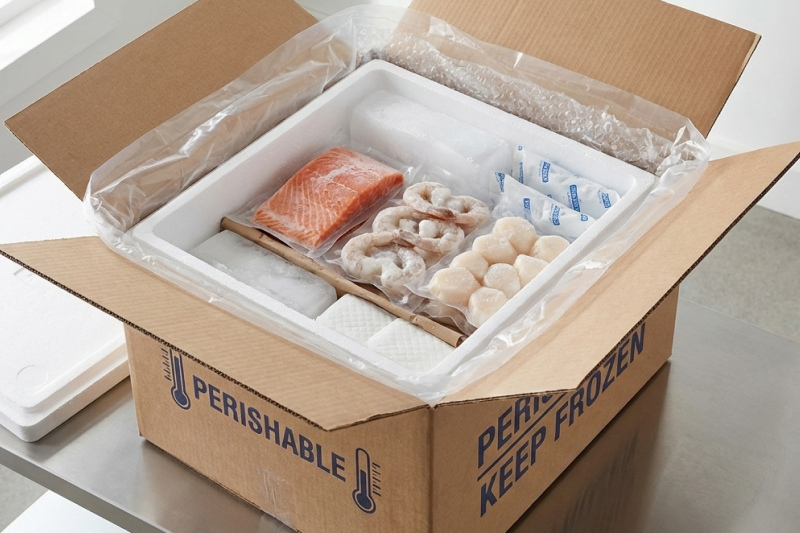
Shipping frozen food requires three things: dry ice, an insulated box, and a carrier service that delivers in 2 days or less. It sounds simple, but if anything goes wrong with any of them, your product arrives as a warm, spoiled mess — and your customer is asking for a refund before the box hits the recycling bin. This guide covers every step, from packaging specs to the mistakes that ruin shipments at scale.
Last updated: April 2026
The Three Things That Matter
Every frozen food shipment comes down to three variables. Get all three right and your product arrives frozen. Get any one wrong and you're reshipping the order — at $80–$200+ including replacement product, packaging, expedited shipping, and customer service time.
- Packaging — an insulated container that holds cold air in and keeps ambient heat out for the full duration of transit
- Dry ice — enough to maintain 0°F or below from the moment you pack the box to the moment the customer opens it
- Speed — a carrier service fast enough that your dry ice doesn't sublimate before the package arrives
Carriers don't control temperature. FedEx, UPS, and USPS move boxes. Your packaging and coolant are 100% responsible for keeping the product cold. There is no temperature-controlled truck, no refrigerated warehouse, no cold room at the sortation hub. From the moment your package leaves your facility, it's on its own.
Temperature Requirements
Frozen food must stay at or below 0°F (−18°C) during transit. Some partially frozen products — like certain seafood — can tolerate up to 28°F (−2°C). Refrigerated items top out at 40°F (4°C). Cross those thresholds and your product starts to go.
Texture degrades, bacteria multiply, and the customer opens a box that doesn't look, smell, or taste like what you sold. Even if the product is only slightly thawed, most customers won't feel safe consuming it — and they shouldn't have to make that call. There's no fixing a warm delivery after the fact.
Temperature Thresholds by Product Type
- Frozen meat, seafood, ice cream0°F (−18°C) or below
- Partially frozen (some seafood)28°F (−2°C) max
- Refrigerated (dairy, juice, produce)32–40°F (0–4°C)
- Danger zone (bacterial growth)Above 40°F — bacteria double every 20 min
When cold foods exceed 40°F, they enter the temperature danger zone where harmful bacteria can double every 20 minutes. Food that sits in this zone for more than 2 hours should be discarded. This is why packaging and dry ice quantities aren't just cost decisions — they're food safety decisions.
Packaging and Insulation
The Outer Box
Use heavy-duty corrugated cardboard rated at least 3× the weight of your product plus dry ice. Single-wall ECT boxes crush under pressure and fail at the corners — especially when stacked in a carrier's truck. The outer box provides structural protection. Your insulation handles the thermal job.
Insulation Options
Polyurethane foam offers roughly 2× the R-value per inch compared to EPS, making it the best thermal performer. It's lightweight and conforms well to products. The trade-off: it's the most expensive and least environmentally friendly. Use it when you need maximum performance for longer transit or extreme heat.
EPS (expanded polystyrene) foam is the industry workhorse. Strong thermal performance at a lower cost. Use 1.5-inch walls for overnight shipments, 2-inch for 2-day transit. Rigid, moisture-resistant, and available in pre-formed shapes. Downside: not biodegradable, limited recycling.
Cornstarch-based insulation performs comparably to EPS and dissolves in water, making it a viable option for eco-conscious brands. More expensive and less widely available, but increasingly popular as a sustainability differentiator.
Whichever you choose, line all 6 sides — top, bottom, and all 4 walls. Gaps let ambient air in and accelerate melt. Corners are where cold air escapes first — make sure they're fully covered.
For a detailed comparison of insulation options and gel pack alternatives to dry ice, see our dedicated guide.
Dry Ice: How Much You Need and How to Use It
Dry ice sublimates at −109.3°F (−78.5°C), making it the standard coolant for frozen food shipments. Unlike gel packs, which maintain refrigerated temperatures (32–40°F), dry ice maintains the sub-zero environment that frozen products require.
Quantity by Service Level
The quantity depends on box size, insulation quality, and transit time. For a standard 12 × 12 × 12″ insulated box with ~30 lbs of frozen product:
Dry Ice Estimates by Service Level
- Priority Overnight (1 day)~4 lbs
- Standard Overnight (1 day)~5.5 lbs
- 2-Day Air (2 days)~10 lbs
- 3-Day / Express Saver (3 days)~15 lbs
Larger boxes, heavier loads, and summer conditions require more. When in doubt, add more — a few extra dollars of dry ice is always cheaper than a reshipped order at $80–$200+.
Ventilation Is Not Optional
Dry ice releases CO₂ as it sublimates. In an enclosed space — a delivery van, a warehouse elevator, a car trunk — CO₂ buildup displaces oxygen and creates a suffocation hazard. Never seal the box airtight. Leave the carrier's tape gaps intact. Don't overwrap. Use standard carrier tape only.
Placement
Place dry ice on all sides of the product, not just on top or bottom. Weigh your dry ice before it goes in and record the weight — you'll need this for the carrier declaration. The declared weight must match the actual weight or you risk a compliance violation.
Sourcing
Buy from industrial gas suppliers for the best bulk pricing. Grocery store dry ice works in a pinch but costs 2–3× more per pound. At $1.00–$1.25 per pound from an industrial supplier at volume, dry ice costs $4–$13 per shipment depending on service level.
Labeling and Compliance
Dry ice is regulated as a Class 9 hazardous material under DOT (49 CFR 173.217) and IATA standards. Every shipment containing dry ice requires proper labeling — this is federal law, not a carrier preference.
Required Markings
- "PERISHABLE" visible on the outside of the box
- Hazard Class 9 diamond label (required when dry ice exceeds 5.5 lbs)
- "Carbon Dioxide, Solid" or "Dry Ice" with UN number UN 1845
- Net weight of dry ice in kilograms
- Full shipper and recipient contact information
Carrier Enforcement
Both FedEx and UPS will pull shipments that don't meet their labeling specs — even when the dry ice quantity is correct. A flagged package means delays, returns, account warnings, fines, or suspension. You don't want a dry ice violation on your carrier account.
Build compliant labeling into your fulfillment workflow as a template, not a manual process. Better yet, use a shipping automation platform that generates the labels automatically based on package contents.
International Shipments
Shipping frozen food internationally adds IATA Packing Instruction 954 compliance (stricter dry ice limits) and country-specific food safety regulations. For the most common international route, see our guide on shipping food to Canada.
Shipping Windows and Timing Strategy
Which Days to Ship
Ship Monday through Wednesday for 2-day services. Thursday shipments require overnight air to land by Friday. Never ship frozen food on Friday unless you use overnight with Saturday Delivery — a delivery failure means your package sits in a non-temperature-controlled facility through the entire weekend. That's 48–72 hours of uncontrolled ambient temperature, which will ruin any frozen product regardless of how much dry ice you packed.
Which Service Level
2-day air is the standard for most frozen food shipments. Overnight costs more but gives you a larger margin for error on packing or delay. Ground shipping is viable only for destinations within 1–2 zones — and only if you've validated your packaging with real transit tests. Avoid economy ground for any frozen product. A package routed through a regional hub over a weekend can sit in a hot trailer for 96 hours.
Internal Cutoff Times
Set your internal order cutoff at 1:00 PM. Orders placed after 1 PM should ship the next business day. A 4:00 PM order that you try to rush out introduces too many failure points — incorrect pack-outs, missed pickups, no time to catch labeling errors. Automate cutoff enforcement. Manual processes break down under order volume.
Seasonal Conditions Change Your Cost Structure
A real example: Chicago to New York. In January, a 2-day shipment with 4 lbs of dry ice will almost always work — ambient temperatures stay low enough that your insulation handles the rest. In August, that same route requires overnight air, 7–8 lbs of dry ice, or both.
Seasonal conditions don't just influence your packing decisions — they change your cost structure entirely. Build a rate model that accounts for summer cost increases before you price your shipping or set free-shipping thresholds.
Holiday and Peak Season
Add 1 extra day to your transit estimate around major holidays. Carrier networks run under surge volume and can fall behind published timelines. During Thanksgiving week, the December holiday window, and Valentine's Day for specialty food brands, many operators shift entirely to overnight service and increase dry ice by 30–50% as a buffer. Communicate cutoff dates clearly on your website, in order confirmation emails, and at checkout.
Step-by-Step: How to Ship Frozen Food
- Check your platform's rules. If you sell on Amazon, Goldbelly, or any marketplace with food safety requirements, read their carrier and packaging rules first. Violating platform rules costs you the account, not just the order.
- Pre-freeze your product. Freeze to 0°F (−18°C) for at least 24 hours before packing. Product that's still cooling when packed will lose temperature faster in transit. This is one of the most common mistakes.
- Stage your materials. Pull your box, insulation panels, dry ice, labels, and tape before you start. Stopping mid-pack to find materials wastes time and introduces errors.
- Prepare the outer box. Line all 6 interior sides with insulation panels. Corners are where cold air escapes first — make sure they're fully covered.
- Load your frozen product. Place product in the center of the box. Don't let it touch the outer walls directly. Wrap everything in leak-proof bags.
- Add dry ice. Weigh it before it goes in and record the weight — you'll need this for the carrier declaration. Place dry ice on all sides of the product, not just on top.
- Fill voids. Air gaps let warm ambient air circulate and accelerate melt. Fill empty space with crumpled newsprint, paper, or extra insulation.
- Seal with ventilation. Use standard carrier tape. Don't overwrap. Don't create an airtight seal — the CO₂ needs a path to escape.
- Label and ship. Apply your PERISHABLE label, hazard Class 9 diamond, and UN 1845 declaration. Confirm the declared dry ice weight matches what you recorded in Step 6. Hand off to carrier.
What It Actually Costs to Ship Frozen Food
The biggest mistake brands make is looking at the carrier rate alone. The true cost includes packaging, coolant, labeling, spoilage losses, and the customer service overhead when things go wrong.
Total Cost Per Frozen Shipment (12 × 12 × 12″ box, ~30 lbs, Priority Overnight)
- Carrier service (Zone 4–5)$30–$55
- Insulated packaging (EPS cooler + outer box)$3–$6
- Dry ice (~4 lbs at $1–$1.25/lb)$4–$5
- Hazmat label + compliance$0.10–$1.00
- Total landed cost per shipment$37–$67
2-day service requires ~5.5 lbs of dry ice for a standard 12×12×12 box, raising the coolant cost to $6–$7. Summer shipping adds 20–40% to total costs due to increased dry ice needs and potential service upgrades.
Reducing Costs Without Increasing Spoilage
- Use multi-carrier routing. Comparing FedEx and UPS rates on every shipment typically saves 15–20% across mixed order volume.
- Right-size your packaging. Oversized boxes increase shipping costs (carriers bill by both weight and dimensions) and waste dry ice cooling empty air.
- Pre-freeze to -10°F or lower. Products packed colder need less dry ice to maintain 0°F through transit.
- Don't establish a direct carrier account too early. New brands should start with a group enterprise account for pre-negotiated rates without volume commitments. Negotiate your own agreement once you have the volume to back it up.
Common Mistakes That Ruin Frozen Shipments
Underestimating transit time
A "2-day" service that gets delayed by a hub reroute can become a 3- or 4-day shipment. Pack for the worst case, not the listed estimate. If transit is quoted at 24 hours, pack for 36–48.
Too little dry ice
Operators frequently underfill dry ice to save weight costs. The cost difference between 4 lbs and 8 lbs is a few dollars. A reshipped order costs $80–$200+, and potentially your customer's confidence. The math is obvious.
Empty space in the box
Air gaps let warm ambient air circulate and accelerate melt. Fill every void with paper, bubble wrap, or extra insulation.
Ignoring seasonal conditions
A packaging configuration that works in February will fail in July. Run validation tests at the start of each season. Don't learn this lesson from a week of spoiled shipments.
Missing or incorrect labels
A package flagged for improper dry ice labeling gets pulled by the carrier. That's a delayed delivery, a potential fine, and a compliance record on your account.
No perishable insurance
Standard carrier liability doesn't cover spoilage. Third-party providers like Route, Shipsurance, and Shippo Insurance do not typically offer perishability coverage either. Check the policy language carefully — most exclude losses from "improper packing." You need insurance with explicit perishability coverage.
Scaling Your Frozen Shipping Operation
Shipping 5 orders a week and shipping 500 a week require fundamentally different systems. Your pack-out process, dry ice sourcing, cutoff enforcement, and quality control all need to be built for the volume you're going toward, not the volume you're at.
What Breaks at Scale
- Manual pack-outs — inconsistency creeps in. One person packs 4 lbs of dry ice, another packs 2. One lines all 6 sides, another skips the top. Build a documented, repeatable process that your team executes the same way every time.
- Manual carrier selection — choosing the right service for every order becomes impossible when you're shipping to 50 different zones. A multi-carrier shipping platform automates this based on rules you set once.
- Manual cutoff enforcement — someone always tries to squeeze in one more order after the cutoff. Automate it.
- Dry ice sourcing — your grocery store supply won't scale. Establish a commercial supplier relationship with consistent supply and bulk pricing before you need it.
Mixed-Temperature Orders
If your store sells both frozen and refrigerated products, customers will inevitably order both in the same cart. You can pack them in the same box with a divided interior and careful dry ice placement — but it's operationally complex and error-prone. Separate boxes with automated split-shipment logic are more reliable and usually more cost-effective at scale.
Delivery Communication
Frozen food deliveries create more customer anxiety than any other category. "Is it still cold? Did it arrive? Should I be home?" A branded tracking page with proactive late shipment alerts reduces "where is my order?" tickets and gives customers confidence that you're watching their shipment — even when they're not.
Frequently Asked Questions
How do you ship frozen food?
Pre-freeze product to 0°F for 24 hours. Pack in an insulated container with dry ice on all sides. Label with UN 1845 Class 9 hazmat markings. Ship via overnight or 2-day express, Monday through Wednesday. The carrier moves the box — your packaging and dry ice keep it cold.
How much dry ice do I need?
For a 12 × 12 × 12″ box with ~30 lbs of frozen product: ~4 lbs for Priority Overnight, ~5.5 lbs for Standard Overnight, ~10 lbs for 2-day, ~15 lbs for 3-day. Larger boxes and summer shipping need more. Always pack for the delay, not the promise.
How much does it cost to ship frozen food?
$37–$67 per shipment for Priority Overnight (carrier rate + packaging + dry ice + labeling). Costs increase for 2-day service due to higher dry ice needs. Summer shipping adds 20–40% to total costs.
Can I ship frozen and refrigerated food in the same box?
You can, but it requires a physical barrier between zones and careful dry ice placement to avoid freezing refrigerated items. It's operationally complex. Separate boxes with automated split-shipment logic are more reliable at scale.
What days should I ship frozen food?
Monday through Wednesday for 2-day services. Thursday requires overnight to land by Friday. Never ship Friday unless using overnight with Saturday delivery — a delay means your package sits unrefrigerated through the weekend.
Do I need special insurance?
Yes. Standard carrier liability excludes perishable goods. Most third-party shipping insurance doesn't cover perishability either. You need explicit spoilage and temperature deviation coverage. Watch for "improper packing" exclusions that insurers use to deny perishable claims.
How far can I ship frozen food?
Cross-country (zones 5–8) works with overnight or 2-day air. Ground shipping is only viable for zones 1–2 with validated packaging. International shipping to Canada is possible with additional licensing and customs documentation.
What if my customer isn't home?
Instruct customers in your confirmation email to plan for delivery or designate a cool, shaded drop location. For high-value orders, use insurance with perishability coverage and send a delivery notification so the customer knows to bring the package inside immediately.